Why local AI exploded in 2026
In two years the market flipped. In 2024, almost every enterprise AI project ran on OpenAI or Anthropic APIs. By April 2026, Premai's research shows 68% of companies running AI in production have moved to a hybrid setup: cloud APIs plus at least one self-hosted, open-weight model.
68%
of production AI users now run hybrid (cloud + local)
Premai Q1 2026
82.5
Qwen3.5-9B MMLU-Pro (beats GPT-OSS-120B)
Qwen Team Technical Report
€35M
EU AI Act maximum fine. For many, local deployment is the cheapest compliance path
EU 2024/1689 Article 99
Three things changed dramatically:
- Open-source models caught up to the frontier. Qwen3.5-9B benchmarks beat OpenAI's GPT-OSS-120B on MMLU-Pro (82.5 vs 80.8), at one order of magnitude smaller.
- EU AI Act transparency rules have applied since August 2, 2026. The high-risk package moved to December 2, 2027 under Reg. (EU) 2026/1744, but the fines are unchanged: up to €35 million or 7% of global revenue. For many companies, local deployment is the simplest compliance strategy.
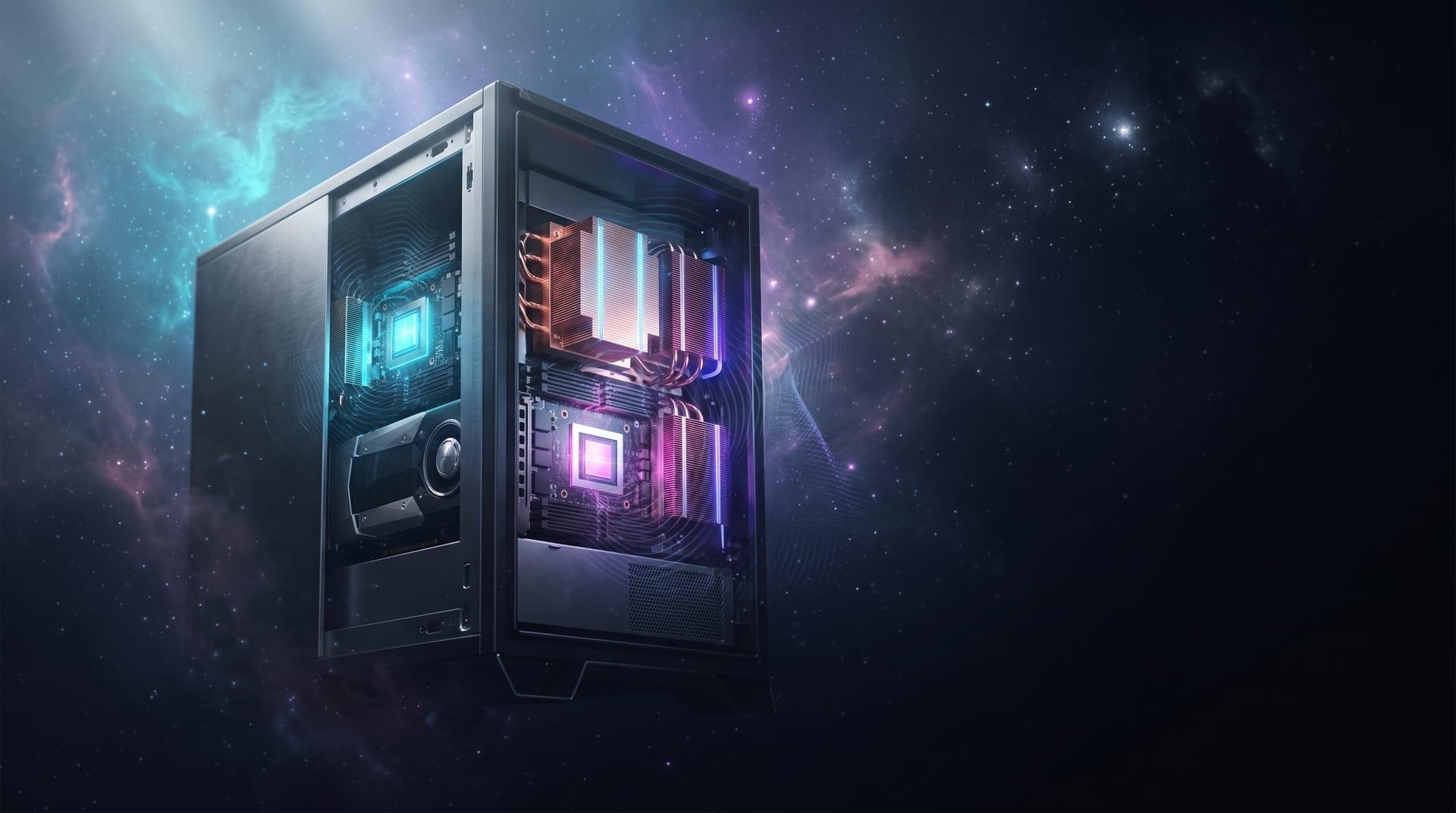
- NVIDIA shipped the DGX Spark. For the first time, there is a desktop "AI supercomputer" at $4,699 that can fine-tune a 70B-parameter model on your desk.
This article is a practical guide: real benchmark numbers, actual prices, and the cases where local deployment pays off. If you want the legal angle, read our EU AI Act and GDPR compliance guide.
What does "local AI" actually mean?
Local AI means the model runs on your infrastructure - no data goes to OpenAI or Anthropic. Three main topologies:
| Topology | Where it runs | Typical fit |
|---|---|---|
| On-premise | Your server room / office | Healthcare, legal, banking |
| Private cloud | Dedicated cloud instances (AWS, Azure, GCP) | EU data-sovereignty-sensitive companies |
| Edge / desktop | Developer machine / DGX Spark / Mac Studio | Prototypes, small teams, R&D |
In all three cases you own the data, and you decide which model runs with which prompts and what gets logged.
Qwen 3.6: fresh release (April 2026)
Alibaba shipped Qwen3.6-Max-Preview on April 20, 2026, followed by the open-weight Qwen3.6-27B on April 22. Third major release this year alone - the tempo says a lot about where Chinese open-source AI development is heading.
What does Qwen 3.6 bring vs Qwen 3.5?
- 260,000 token context window (vs Qwen 3.5's 128k), so an entire codebase fits in one prompt
- The
preserve_thinkingflag keeps reasoning tokens across turns in agentic workflows, so tool-call chains hold context - Agentic coding gains: SkillsBench +9.9 points, SciCode +10.8, Terminal-Bench 2.0 +3.8 vs 3.5
- Six #1 rankings on leading code benchmarks (SWE-bench Pro, SciCode, SkillsBench, others)
The Qwen3.6-27B open-weight version can run on-prem today. Qwen3.6-Max-Preview is currently API-only via Alibaba Cloud Model Studio (qwen3.6-max-preview model ID, OpenAI-compatible endpoint).
Sources: Qwen 3.6 Max Preview official blog, QwenLM/Qwen3.6 GitHub.
Qwen 3.5 and 3.6: the open-source revolution
Alibaba's Qwen family has become the de facto standard for open-weight LLMs in European enterprise by 2026, primarily because of the Apache 2.0 license (commercially usable without restrictions, unlike Llama's custom license).
Qwen 3.5 / 3.6 benchmark numbers (2026 Q1–Q2)
| Model | MMLU-Pro | HumanEval (code) | RAM | Speed (RTX 4090) |
|---|---|---|---|---|
| Qwen3.5-4B | 64.1 | 71.3 | 8 GB | ~120 tok/s |
| Qwen3.5-9B | 82.5 | 78.4 | 16 GB | ~85 tok/s |
| Qwen3.5-27B | 71.2 | 85.1 | 24 GB | 55 tok/s |
| Qwen3-30B-A3B (MoE) | 79.8 | 82.0 | 20 GB | ~70 tok/s |
| Qwen3-32B-Coder | 73.9 | 88.0 | 32 GB | ~45 tok/s |
| Qwen3.6-27B (new) | 73.5 | 86.4 | 24 GB | ~50 tok/s |
Sources: Qwen Team Technical Report, Local AI Master 2026 benchmarks.
What this means in practice
- Qwen3.5-9B is the sweet spot for most SMBs. A 24 GB RTX 4090 or an M3 Pro Mac can run it, and it outperforms GPT-OSS-120B on general knowledge benchmarks.
- Qwen3-32B-Coder is the one to pick for code generation: 88% on HumanEval, better than DeepSeek V3.2 Speciale (82.6%), which needs 8× H100s.
- Qwen3-30B-A3B (Mixture of Experts) activates only 3B parameters, so latency stays low while knowledge capacity stays at 30B. 73–87% pass accuracy on the AIME 2024 math benchmark.
Use cases our clients ask for most often
- Internal document assistant (RAG over policy + HR + technical docs)
- Customer service chatbot where data exfiltration is not an option (e.g., healthcare)
- Code autocomplete when source code is internal and cannot go to Cursor / Copilot
- Invoice / document extraction with GDPR-sensitive data
NVIDIA DGX Spark: the desktop AI supercomputer
NVIDIA shipped the DGX Spark in late 2025, then in February 2026 raised the price from $3,999 to $4,699, citing memory supply constraints (official NVIDIA notice).
The specs
- GB10 Grace Blackwell Superchip: 5th-gen Tensor Cores, FP4 support
- CPU: 20-core Arm (10× Cortex-X925 + 10× Cortex-A725)
- Unified memory: 128 GB LPDDR5x @ 8,533 MT/s
- Memory bandwidth: 273 GB/s
- AI compute: 1 petaFLOP at FP4
- Max model size: 70B for fine-tuning, 200B for inference
Real DGX Spark benchmarks (GPT-OSS 120B, 128k context)
| Hardware | Prefill (tok/s) | Decode (tok/s) |
|---|---|---|
| DGX Spark (NVFP4) | 1,723.1 | 38.55 |
| AMD Strix Halo (MXFP4) | 339.9 | 34.13 |
| 3× RTX 3090 (MXFP4) | 1,641.9 | 124.03 |
Source: IntuitionLabs DGX Spark Review.
NVIDIA's CES 2026 software update (TensorRT-LLM optimizations + speculative decoding) brought a 2.5× performance improvement over launch, and an 8× boost for video generation.
When does the DGX Spark make sense?
Yes:
- Prototype development is the main use case (testing many models, fine-tuning)
- NVIDIA stack (CUDA, TensorRT, NIM) integration is a must
- You need a compact, desktop form factor (1U mini-PC size in the office)
- EU AI Act compliance prevents cloud deployment
No:
- Many concurrent users in production → multiple RTX 4090 / RTX 5090 servers are cheaper
- Inference-only, no fine-tuning → 2× RTX 4090 is cheaper and faster
- You are cost-sensitive and not locked into the NVIDIA ecosystem
Alternatives in the same category
| Device | Unified memory | Bandwidth | Price (2026 Q2) |
|---|---|---|---|
| NVIDIA DGX Spark | 128 GB | 273 GB/s | $4,699 |
| Apple Mac Studio M4 Ultra | 192–512 GB | >800 GB/s | $5,999–$11,999 |
| AMD Strix Halo (Ryzen AI Max+ 395) | 128 GB | 256 GB/s | ~$2,500 |
| 2× RTX 5090 build | 64 GB GDDR7 | 1,792 GB/s | ~$5,500 |
Source: Tom's Hardware DGX Spark Review.
The Mac Studio M4 Ultra beats the Spark on raw memory bandwidth and can run larger models (up to 405B parameters with the 512 GB config). Downside: no CUDA, so a lot of ML tooling works only partially.
Hybrid strategy: when local, when cloud?
Best practice in 2026 is not "everything local". It is the right model for the right job.
When local Qwen / Llama / DeepSeek wins
- High-volume, repetitive tasks (e.g., document classification on 50,000/day)
- Sensitive data (PII, healthcare, legal, financial)
- Deterministic responses (same input → same output, fixed model version)
- Latency-critical (5–20ms over LAN vs 200–500ms cloud)
When cloud APIs (OpenAI / Anthropic / Google) win
- Frontier capability (Claude Opus, GPT-5-class complex reasoning)
- Bursty usage (a few thousand tokens/month - no point owning idle GPUs)
- Multi-modal (video understanding, image generation, where cloud is still ahead)
- Massive context (1M+ tokens in a single call)
The break-even point: fresh 2026 data
Premai's Q1 2026 analysis:
- 5M tokens/day average: 18–24 months payback for on-premise
- 10M tokens/day and above: 12–18 months payback
- 70B production-grade environment: $40,000–$190,000 upfront
- Hidden costs: +40–60% (operations, power, updates)
- 3-year savings: up to 50% vs cloud APIs at full utilization
Sources: Premai On-Premise LLM Deployment, SitePoint TCO Analysis 2026.
European SMB context
A mid-market client of ours switched from OpenAI API to Qwen3.5-9B + RTX 4090 in January 2026:
- Before: €1,800/month OpenAI API (avg 8M tokens/day)
- After: €4,200 one-time hardware + ~€120/month power + ops
- Payback: end of month 4
- Compliance: their hospital partner finally signed off, because patient data never leaves the country
Implementation stack in 2026
Inference server
- vLLM 0.7+ is the de facto standard, with an OpenAI-compatible API
- TensorRT-LLM for NVIDIA, when you need maximum speed
- Ollama 0.19+ on the developer machine; with MLX on M-series Macs it runs at nearly 2× speed
- llama.cpp for CPU-only or GGUF-quantized models
DGX Spark + vLLM quickstart: spark-vllm-docker
The worst Spark experience would be spending 2–3 days configuring vLLM for the CUDA 12.1a architecture. The community project eugr/spark-vllm-docker is built specifically for DGX Spark (NVIDIA GB10, sm_121a).
What it gives you:
- Prebuilt vLLM wheels from GitHub Releases, tested nightly, so no source compilation is required
- Multi-node Ray cluster: link two or three DGX Sparks together via InfiniBand / RoCE
- Preconfigured model recipes: Qwen 3.5-397B (yes, 397B parameters across three Sparks), Qwen3-Coder-Next, MiniMax M2/M2.5, GLM-4.7, Nemotron, GPT-OSS-120B
- Quantization support: AWQ, INT4-AutoRound, NVFP4, FP8
- FastSafeTensors for faster model loading
- Non-privileged container, safe to run in production
Solo (single Spark) startup:
git clone https://github.com/eugr/spark-vllm-docker.git
cd spark-vllm-docker
./build-and-copy.sh
./launch-cluster.sh --solo
For a two-Spark cluster, use the -c flag and the multi-node options of launch-cluster.sh.
Model management & RAG
- Qdrant or Weaviate for the vector DB
- LangChain or LlamaIndex as the RAG framework
- Langfuse (self-hosted) for observability and prompt tracking (detailed comparison with LangSmith)
Security layer
- Garak or Promptfoo for prompt injection testing
- NeMo Guardrails for output filtering
- Llama Guard 3 for content moderation, locally
Common gotchas: what marketing materials do not tell you
1. Memory ≠ performance
The DGX Spark with 128 GB unified memory is slower at generation than a 24 GB RTX 4090 when the model is a 9B. Big memory only helps if you actually need the capacity.
2. Quantization has a quality tax
A Q4-quantized 70B model loses 8–12% MMLU points vs Q8. Most published benchmarks use Q8/FP16. In production you will likely run Q4–Q5.
3. Long context is expensive
128k context window memory grows quadratically. A 32B model at 128k context needs 60–80 GB VRAM just for attention cache.
4. Fine-tuning (LoRA) is not a silver bullet
LoRA fine-tuning does not write knowledge into the model. It does not replace RAG. If you need to answer questions about your company docs, build RAG, not LoRA.
5. The operational burden is real
An on-prem AI system needs daily oversight: GPU monitoring, model updates, security patches. Without DevOps capacity, cloud will be cheaper long-term too.
Decision matrix for European SMBs
| Company size | Use case | Recommended stack |
|---|---|---|
| 1–10 staff | Experimentation, prototypes | Ollama + Qwen3.5-9B on M3/M4 Mac |
| 10–50 staff | Internal chatbot, RAG | RTX 4090 + vLLM + Qwen3.5-27B |
| 50–200 staff | Production AI 100+ users | DGX Spark or 2× RTX 5090 + vLLM |
| 200+ staff | Enterprise + compliance | Multi-GPU node + Kubernetes + private Qwen / Llama |
Where to start
If you are starting with local AI, do not buy hardware first. The 5-step workflow:
- Define one concrete use case (e.g., "extract invoices with German VAT")
- Measure token volume (how much per day?)
- Test in cloud first (1–2 weeks on OpenAI / Anthropic API → validate the concept)
- Try open-weight models in cloud (Together.ai, Fireworks, Groq → same Qwen / Llama, just not your machine)
- Only then go local, if token volume justifies it
Most companies discover at step 3 that their OpenAI bill is 3× the cost of running Qwen3.5-9B on Together.ai - without buying a server.
Free AI infrastructure consultation
If you want to know whether your company's AI workload pays off locally or in the cloud, our 30-minute free consultation covers:
- Current AI spend
- Data sensitivity and compliance requirements
- Expected growth
- Recommended model + hardware stack
- Expected payback in months
Request a free consultation, or check our free SEO + AI audit for a broader digital strategy review.
Frequently asked questions
What is local AI deployment?
Local AI means the model runs on your infrastructure: on-premise server, private cloud, or edge device (DGX Spark, Mac Studio). Data never leaves the company, you choose the model version, and you control the logs.
How much does a local AI system cost in 2026?
Entry: Ollama + Qwen3.5-9B on an M3 Pro Mac (~€1,500). Production stack for 50 users: RTX 4090 + vLLM + Qwen3.5-27B (~€4,000 hardware + ~€200/month power). Enterprise (200+ staff): DGX Spark or 2× RTX 5090 (~€5,500) on a Kubernetes cluster. A 70B production environment: $40,000–190,000 upfront.
Which open-source LLM is best in 2026?
The Qwen 3.5 family is the de facto standard in European enterprise: Apache 2.0 license (commercial use allowed), Qwen3.5-9B at 82.5 MMLU-Pro (beating GPT-OSS-120B), Qwen3-32B-Coder at 88% HumanEval. Qwen 3.6-27B (April 2026) shipped a 260k context window, tuned for agentic workflows.
Is the NVIDIA DGX Spark worth it?
Yes if prototype development is the main use case (testing many models, fine-tuning), NVIDIA stack integration matters, or compliance prevents cloud deployment. No if you need many concurrent users in production, where 3× RTX 3090 or 2× RTX 4090 is cheaper and faster on token generation (124 vs 38 tok/s decode).
When does local AI pay back?
Premai's Q1 2026 analysis: 18–24 months at 5M tokens/day, 12–18 months above 10M tokens/day. A real European mid-market client switched from OpenAI API to Qwen3.5-9B + RTX 4090 at 8M tokens/day. Payback hit at the end of month 4 (€1,800/month → €4,200 one-time + €120/month power).
How does local AI help with EU AI Act compliance?
Three areas. (1) Data localization: data never leaves the EU, so Schrems II issues vanish. (2) Fixed model version: the AI Act requires high-risk AI to behave in a documented way, and locally you choose when to update. (3) Audit capability: the regulator can retrospectively check what the model said on a given day.
What software stack should I use?
Inference: vLLM 0.7+ (production), Ollama (development), TensorRT-LLM (max NVIDIA speed). RAG: LangChain + Qdrant / Weaviate. Observability: Langfuse self-hosted. Security: Garak or Promptfoo (prompt injection testing), NeMo Guardrails (output filtering), Llama Guard 3 (content moderation). For DGX Spark, eugr/spark-vllm-docker is built specifically for it.